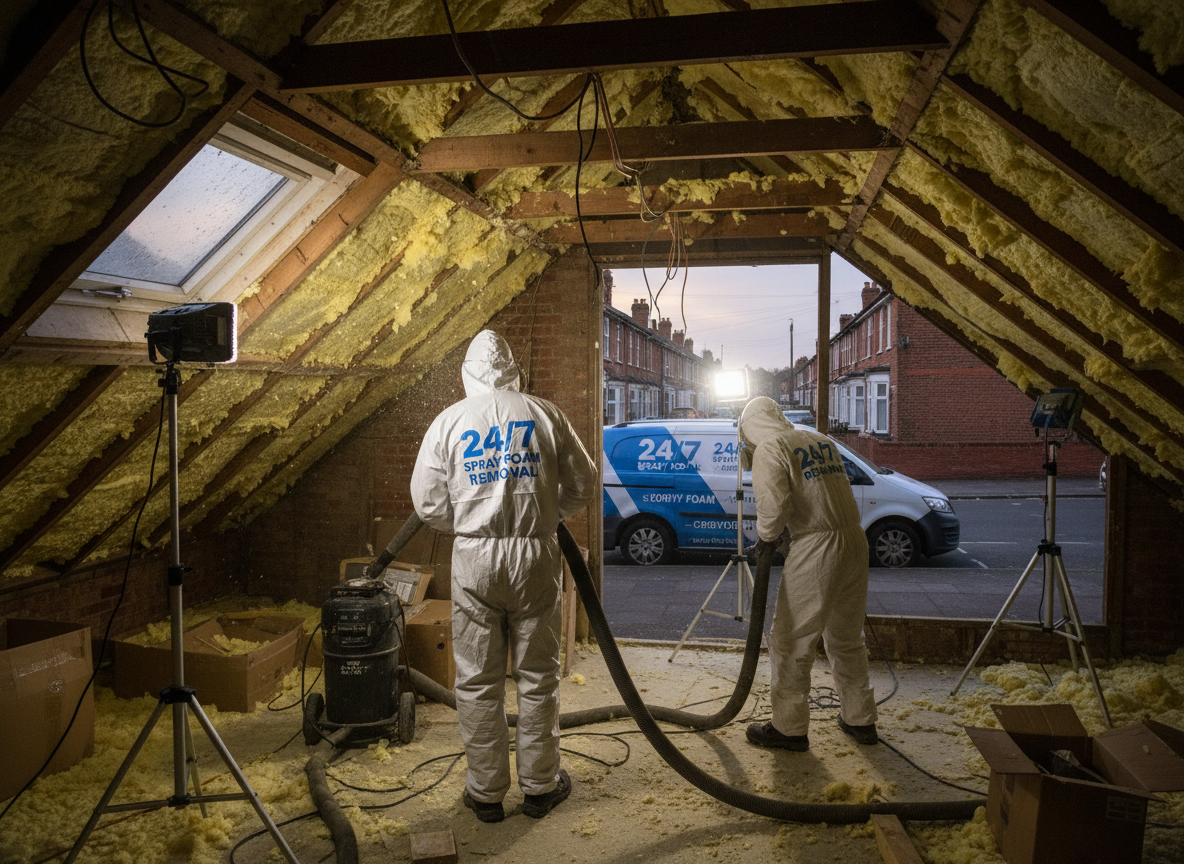
Croydon’s housing stock includes many Victorian terraces in areas like Thornton Heath and South Norwood plus 1960s-1970s semis around Addiscombe where spray foam was blown into lofts decades ago. Over time the closed-cell material traps moisture against original timber joists and can lead to rot, especially after the heavy autumn rainfall common in the Croydon area. Removal requires cutting back to the joists, vacuum extraction of residue, and checking for hidden damp before any new insulation is considered.
Night and weekend call-outs are routine because homeowners often discover the problem when a leak appears during a storm. The work starts with negative-pressure containment to stop dust migrating into living spaces below, followed by mechanical scraping and HEPA filtration. In properties near the railway lines around East Croydon the vibration from passing trains can loosen foam that has already delaminated, so crews check fixings twice before leaving site.
Local building control expects any new insulation to meet current ventilation standards; leaving foam in place can void roof warranties on older pitched roofs. Crews always photograph joist condition before and after so the homeowner has a record for future surveys.
Access through small loft hatches in narrow terraces demands sectional equipment rather than full sheets, and waste must be bagged on site to avoid blocking the narrow pavements common in central Croydon streets.
Technician insight
In Croydon the thing that catches most people out with 24/7 Spray Foam Removal is the 1930s semis around Shirley where the foam was sprayed straight onto the original sarking felt; once you start pulling it the felt tears and you suddenly have daylight showing through the roof tiles that needs immediate temporary covering before the next rain.
Thornton Heath Terrace Loft
Homeowner noticed damp patches on bedroom ceilings after winter storms. Inspection showed closed-cell foam had trapped condensation against the rafters in a 1900s terrace. Crew removed the foam under negative pressure, treated surface mould on the joists, and fitted temporary ridge vents until new insulation could be installed.
How it works
- 1
Emergency Call-Out
Technician arrives within hours, assesses loft access and foam condition while the property remains occupied.
- 2
Containment Setup
Negative-pressure tenting and dust extraction protect living areas below before any cutting begins.
- 3
Foam Extraction
Mechanical removal down to the joists followed by vacuuming of residue and inspection for timber damage.
- 4
Site Clearance
All waste removed, ventilation checked, and photographs supplied for the homeowner’s records.
Pricing
Cost depends on loft size, foam depth and access; quotes given after inspection.