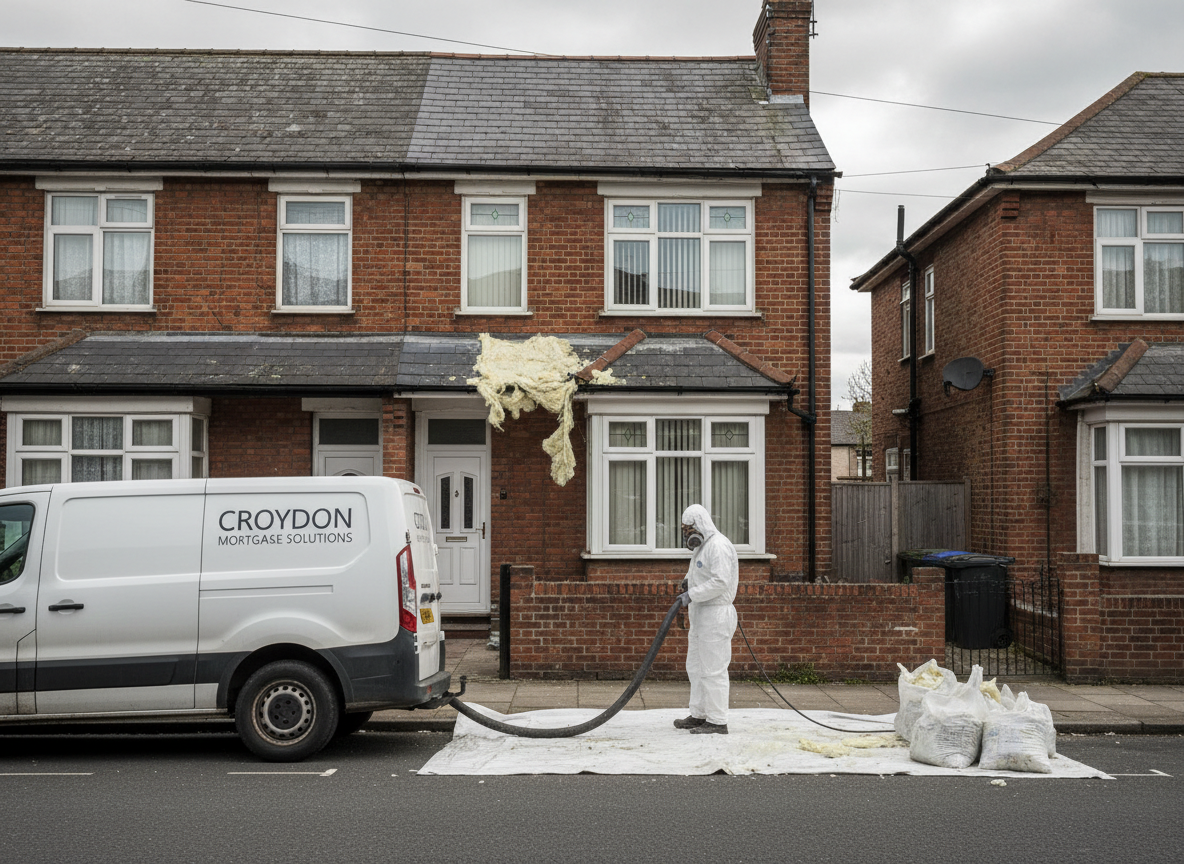
Croydon’s older housing stock, particularly pre-1930 terraces in areas like Thornton Heath and South Norwood, frequently contains closed-cell spray foam applied directly to roof undersides or into cavities. Mortgage lenders often reject these installations because they trap moisture against timber and brickwork, accelerate rot, and breach current UK building regulations on ventilation and fire performance. Removal requires careful mechanical stripping followed by substrate drying and ventilation reinstatement before a fresh survey can proceed.
London’s clay-heavy soils and frequent winter rainfall create persistent damp conditions that make foam removal more complex in Croydon properties. Foam often extends into hidden voids around chimney breasts and party walls shared with neighbouring homes, demanding sectional access rather than simple loft clearance. Incomplete removal leaves lenders unconvinced, so we document every stage with photos and moisture readings to satisfy surveyors working for Halifax, Santander and similar high-street lenders.
Edge cases in post-war Croydon estates include foam sprayed over electrical cabling and pipework, which must be isolated before extraction to avoid damage claims. We use low-impact negative-pressure systems to contain dust within the roof void, protecting habitable spaces below. Once cleared, we advise on compliant alternatives such as mineral wool or rigid boards that meet lender and building control standards without repeating the original moisture problems.
Common Triggers for Lender Rejection
Surveyors flag spray foam when they detect blocked eaves ventilation, elevated timber moisture or foam covering rafters in Croydon lofts. Early removal prevents valuation delays that can derail sales in a competitive Greater London market.
Technician insight
In Croydon, the thing that catches most people out with mortgage lender spray foam removal is how far the foam has crept into the eaves and behind chimney stacks in 1920s terraces around Addiscombe; once winter rain soaks the clay soil, those hidden sections stay damp and trigger repeated lender rejections if not fully stripped.
Thornton Heath Terrace Mortgage Hold-up
A 1930s mid-terrace in Thornton Heath failed its mortgage survey because closed-cell foam covered the entire loft and bridged into the party wall. We found the foam had trapped condensation against the rafters and extended behind the chimney. After sectional removal and drying, moisture readings dropped below 15 percent. The lender accepted the clearance pack and the sale completed without further delay.
How it works
- 1
Initial Survey and Lender Liaison
We inspect the property, identify foam extent, and confirm the exact lender requirements before quoting.
- 2
Safe Access and Containment
Temporary protection is installed and negative-pressure extraction set up to isolate the work area.
- 3
Mechanical Foam Removal
Foam is cut and peeled in sections, with hidden extensions into cavities and around services fully cleared.
- 4
Substrate Drying and Documentation
Moisture readings are taken, voids are ventilated, and a full photographic record is supplied for the lender.
- 5
Final Handover
We confirm the loft meets survey standards and advise on compliant re-insulation options if required.
Pricing
Pricing reflects property age, foam volume and access difficulty; we issue a fixed quote after the site visit.